2026 Funding Awards
Riccardo Monti, Università degli Studi Milano-Bicocca, EGU 2026, Vienna
I would like to sincerely thank TSG for awarding me a Student Travel Grant, which supported my participation in the EGU General Assembly 2026 in Vienna, Austria, where I had the opportunity to present the final stages of my PhD project.
During EGU26, I contributed to the oral session “Geo-modelling for the Future: Advances in Structural and Reservoir Modelling for the Energy Transition”, co-organized by the Energy, Resources and the Environment (ERE) and Tectonics & Structural Geology (TS) divisions, with a presentation entitled “The Structural Topology Model: integrating topology and ontology in 3D geological modelling”.
In this work, I presented the workflow of the Structural Topology model (STm), an approach designed to integrate the ontological component within 3D structural geological models and to support the topological validation of both surface and volumetric geological elements.
The method was developed to support 3D modellers working in polymetamorphic settings, where a usable stratigraphy is often absent and where intense deformation together with structural overprinting generates extremely complex geological contacts. At EGU, I presented applications of the STm in the upper Lys Valley (Monte Rosa, Italy) and in the Eastern Tauern Dome (Austria).
In addition, as co-author of four other posters, I had extra opportunities to discuss these topics with structural geologists, 3D modelling specialists, and experts from national geological surveys. These discussions covered both well-established case studies, such as the Aar Massif in Switzerland, and potential new applications in more sedimentary environments, where unit boundaries may change their ontological meaning significantly laterally. The exchange of ideas provided many valuable insights and opened new perspectives for future developments, both from a theoretical and methodological point of view.
The posters for which I was co-author, and where I also contributed to the presentation and provided support on site as an expert user of our 3D modelling software PZero, were:
- PyMeshIt: An Open-Source Python Modelling Engine in PZero and a Standalone Software for Conforming Tetrahedral Mesh Generation
- 3D Geomodel of the Eastern Tauern Dome (Tauern Window – Eastern Alps)
- Indentation Tectonics in the Swiss Préalpes Romandes Caused by the Uplift of the Aar Massif: Insights from High-Resolution 3D Structural Modelling
- 3D Modelling and Retrodeformation of the Western Helvetics: Insights from the swissAlps 3D Project
I would therefore like to thank TSG once again for supporting this intense and inspiring scientific experience at EGU26, which represented a key milestone in my PhD journey.
2025 Funding Awards
Namgwon Kim, University of Strathclyde, EGU 2025, Vienna
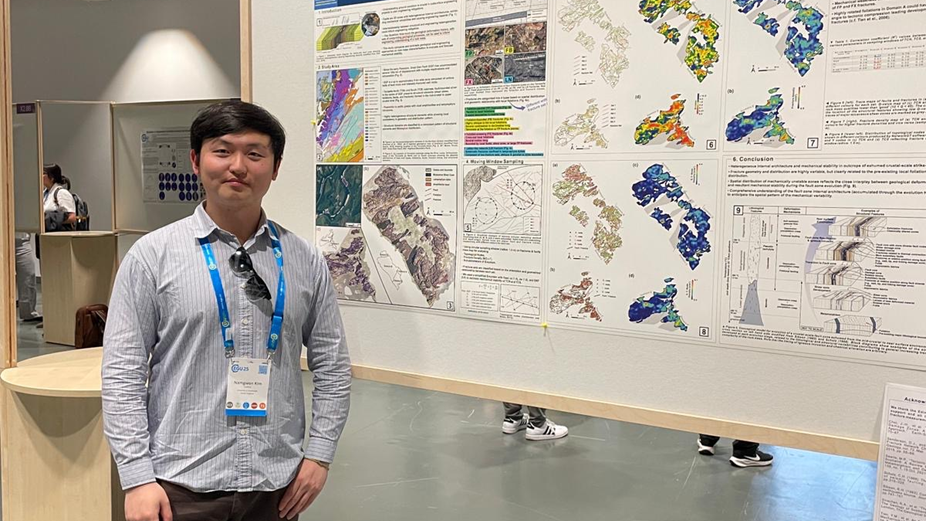
I am very grateful to TSG for providing me a “Student travel bursary”, which enabled my attendance at the EGU General Assembly 2025 in Vienna, Austria. At EGU, I presented a poster titled “Deciphering Heterogeneous Mechanical Stability in an Exhumed Fault Zone through a Structural-Geotechnical Approach: A Case Study from the Great Glen Fault, Scotland.” This study focuses on understanding how the internal architecture influences heterogeneous mechanical stability of the fault zone. My case study site, the Torcastle block, a fault-bounded sliver within the fault core of Great Glen Fault, contains variably oriented faults, micaceous shear zones, and intruded dykes showing heterogeneous fracture patterns. Using a combined approach of detailed structural and geotechnical mapping (e.g., structural domaining, fracture categorization, topological analysis, and Q-value mapping), I aim to understand how geological heterogeneity governs mechanical variability distribution. My findings show that zones with low Q-values, indicative of mechanical weakness, correlate strongly with structural complexity, especially near major faults, rotated blocks, and dyke-influenced domains.
The bursary allowed me to present this work at EGU to an international and multidisciplinary audience, gain valuable feedbacks, and connect with researchers in structural geology, geotechnical engineering, and rock mechanics. The comments I received, particularly on the methods of integrating structural and engineering datasets, was highly constructive and will guide the further development of my project. The experience was especially beneficial as I begin to explore how my findings may apply to geotechnical risk mitigation in infrastructure projects and subsurface engineering.
As my PhD funding does not include conference travel support, the TSG bursary was essential to making this experience possible. Attending EGU 2025 was a significant milestone in my academic journey to strengthen my research and broaden my network. Sincere thanks to TSG.


Follow Us!